
621st Contingency Response Group and 22nd Marine Expeditionary Unit Marines Expand Caribbean Airlift Capabilities
By 1 Lt Jessica McLaughlin, 621st Contingency Response Wing Public Affairs
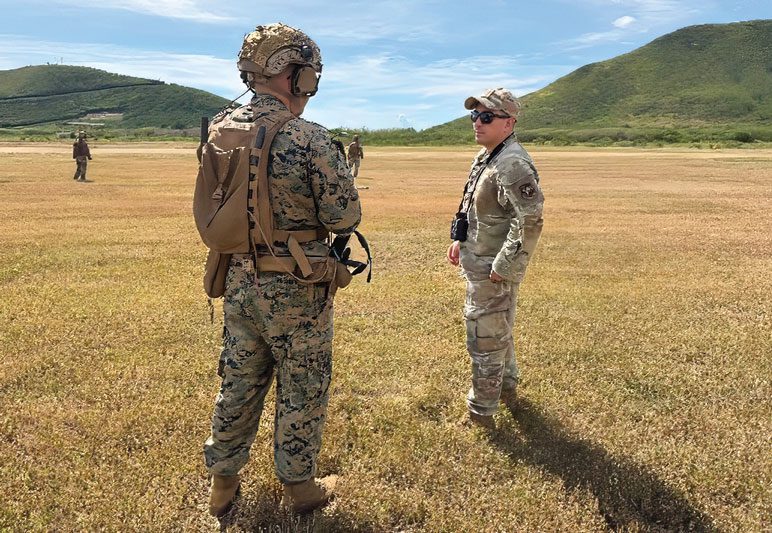
Airmen from the 621st Contingency Response Group (621 CRG) recently collaborated with a Marine Mobile Air Traffic Control Team from the 22nd Marine Expeditionary Unit (22 MEU) to significantly expand airlift capabilities in the Caribbean. The joint team surveyed and certified a C-130 landing zone on the island, opening the area to additional mobility aircraft platforms.
This effort was a model of inter-service cooperation, with the 621 CRG Airmen integrating with their U.S. Marine partners to share tactics, techniques, and procedures for landing zone operations. The collaboration created valuable synergy for future joint missions in the region.
Combat engineers from Battalion Landing Team 3/6, 22 MEU (Special Operations Capable), delivered a major enhancement to Camp Santiago’s operational infrastructure by constructing a KC 130J Super Hercules-capable runway.
Their work required precise surveying, grading, compaction, and surface preparation to meet the requirements of a C130 landing zone, transforming an undeveloped stretch of terrain into a fully functional tactical airstrip. This engineering achievement fundamentally expanded Camp Santiago’s training and mobility capabilities, creating a direct link between ground forces operating in Puerto Rico and the MEU’s airlift platform.
By enabling KC130J aircraft to land, refuel, and support distributed training events, 22 MEU Marines effectively bridged the gap between land-based exercises and rapid, theater-relevant lift capacity. Their work both strengthened joint forces’ ability to project combat power across the Caribbean and left a lasting imprint on the theater.
In addition to the new landing zone, an engineering team from the 621 CRG deployed to conduct a critical pavement analysis, ensuring airfields are ready for contingency staging. The task force also surveyed two new drop zones, providing essential training locations for pararescue squadrons and boosting their proficiency in emergency response scenarios.
During operational lulls, the team conducted extensive academic refreshers on airfield criteria, operational procedures, and equipment fundamentals. This continuous training ensures that all personnel remain proficient and prepared for rapid deployment.