
Pushing Boundaries: What Artemis II Can Teach Airmen About the Future of Mission Success
By Ms. Lauren Fosnot, Staff Writer
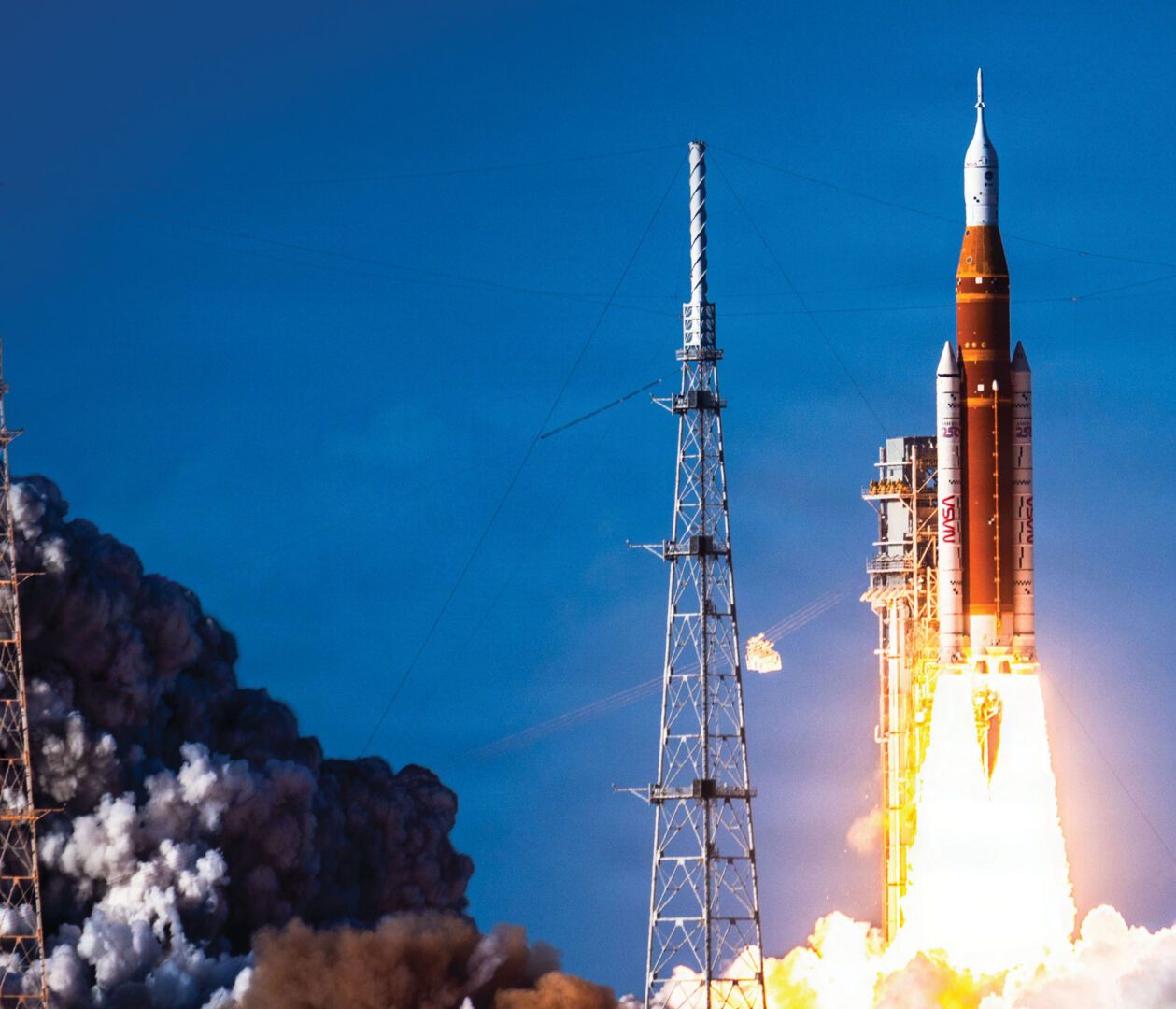
On April 1, 2026, when four astronauts lifted off aboard the National Aeronautics and Space Administration’s (NASA) Artemis II mission, it marked far more than another trip into space. The ten-day mission around the Moon represented the first crewed flight of NASA’s Artemis program and humanity’s return to deep-space exploration after more than five decades.
Artemis II sent Commander Reid Wiseman, pilot Victor Glover, mission specialist Christina Koch, and mission specialist Jeremy Hansen on a journey more than 230,000 miles from Earth aboard the Orion spacecraft and Space Launch System rocket. The mission tested systems, technology, and human performance while laying the foundation for future lunar operations and long-term space exploration.
However, Artemis II was not simply about reaching the Moon. It was about preparing for missions yet to come, and it was, in many ways, deeply human.
Despite the historic use of technology and the staggering distances traveled, the astronauts faced stress, discomfort, communication challenges, and the everyday realities of living and working together in a confined environment. Those moments reminded everyone that even in the most innovative situations, success still depends on humans—their resilience, adaptability, trust, and ability to work together under pressure.
Such a mindset is familiar to Airmen.
Across the Air Force, innovation increasingly means preparing for future operational environments before they fully emerge. Whether adapting to rapidly evolving technology, integrating artificial intelligence into operations, or operating modernized aircraft and communications systems, mission success depends on organizations willing to test, learn, and evolve before a crisis occurs.
NASA’s long-term vision includes sustained lunar operations, expanded scientific discovery, and eventually, deeper space exploration. To accomplish that, the agency must prepare crews, systems, and procedures for environments that cannot be fully replicated on Earth.
Such preparation mirrors the operational reality Airmen also face.
Future conflicts and operational demands will likely look different from those of the past. Technological advances, cyber threats, contested logistics, autonomous systems, and information warfare continue to reshape how missions are executed. Waiting until those environments fully materialize is not an option.
Instead, readiness must be built early. Training exercises, simulations, evaluations, operational testing, and experimentation all serve the same purpose: preparing people and systems for uncertainty. Artemis II demonstrated that innovation is not simply about inventing new technology. It is about creating the capability to operate effectively in unfamiliar conditions.
One of the most significant aspects of Artemis II was placing humans aboard the spacecraft during operational testing. Artemis I proved the systems could function without a crew; Artemis II proved systems could safely support people in deep space—a significant distinction.
For Airmen, this reinforces the value of training environments that expose weaknesses before real-world operations do. Effective training does not avoid friction points; it deliberately incorporates them to improve performance.
Artemis II also highlighted the importance of validating systems as part of an integrated mission rather than in isolation. Spacecraft, communications systems, navigation, environmental controls, and human performance all had to work together seamlessly. A single weak point could have jeopardized the mission.
Military operations function much the same way. Aircraft, maintenance, logistics, communications, intelligence, cyber capabilities, and personnel must all operate as a connected system. Innovation succeeds when organizations test how each piece interacts under realistic conditions. Despite the advanced technology, human performance remains central to mission success. For Airmen, this lesson is especially important as automation and artificial intelligence continue to expand across operations. Advanced systems can improve efficiency and situational awareness, but people remain responsible for decision-making, crew coordination, fatigue management, and mission execution.
Artemis II also reinforced the importance of collaboration. While astronauts are the visible face of a mission, thousands of NASA engineers, technicians, logisticians, scientists, contractors, and support personnel contributed to its success. The mission also reflected the importance of international partnerships, including cooperation between NASA and the Canadian Space Agency. No single organization accomplishes missions of that scale alone.
The same is true across military operations. Mission success increasingly depends on integrated support across commands, specialties, armed services, coalition partners, and industry. Large-scale success is rarely the result of one breakthrough moment; more often, it comes from thousands of coordinated actions performed consistently and effectively across an enterprise.
Lastly, Artemis II demonstrates that innovation is not a single event—it is a continuous process.
For Airmen, that means remaining curious, adaptable, and committed to improvement even when challenges arise. It means understanding that modernization is not solely about equipment, but also about mindset and practice.
As further exploration pushes past the boundaries set with Artemis II, certain characteristics remain remarkably grounded: trust (trusting the team), readiness (testing relentlessly), and intelligence (adapting continuously). Whether in space or within Earth’s atmosphere, progress has always depended on courage, teamwork, and the belief that the next horizon is worth reaching for.