
Does My Deviance Look Normal to You?
By Col John B. Kelley, Director of Safety, Air Mobility Command
In the early days of the internet, back in the late nineteen nineties, online personality quizzes were frequently sent as chain letters via email between friends and coworkers. These emails were welcome distractions as multiple days might elapse without receiving an email in your AOL Mail, Netscape, or Hotmail inbox. In those days, there were very few official Air Force email accounts—happier days indeed! One such quiz promised to calculate your “deviant” percentage—the higher your score, the more your personality deviates from the quintessentially normal, average, “Mark 1” person. While I am not about to trust an internet quiz to define my personality again, such a quiz makes one reflect on how much deviation is innovative and creative, and how much is risky or even dangerous.
I was reminded of this now ancient quiz recently while discussing risk, readiness, training, and operational tempo with my fellow staff dwellers at the Air Mobility Command (AMC) mothership. You see, deviation from normal operations is the topic du jour given the rapid changes in operations, deployments, and organization. The demands of preparing for high-end conflict in the Pacific or European theaters have generated an incredible appetite for innovation and acceleration across the Air Force. In the search for viability, connectivity, and lethality, Airmen across AMC have answered the call with imagination, determination, and grit. To succeed in these new and challenging situations, airpower and its practitioners must deviate from normal, historical ways of doing business and respond to changes in the nature and speed of warfare. These changes could lead to advances in wartime capabilities. However, they also bring new risks and increasing pressure for Airmen on the line to accelerate, and on the commanders who lead them.
One of the most common human-centric risks that comes with a high operations tempo and pressure to perform at speed is the temptation to take shortcuts in existing procedures, accept performance as “good enough,” or substitute personal techniques in place of approved procedures. Over time, these modifications to processes or standards become habit; we forget the additional risks inherent with these changes. We tell ourselves, “It always worked in the past with no consequences, it should work now.” This slow creep of performance away from the standard is infamous in the academic safety world. The phenomenon even has an ominously cool name: Normalization of Deviance.
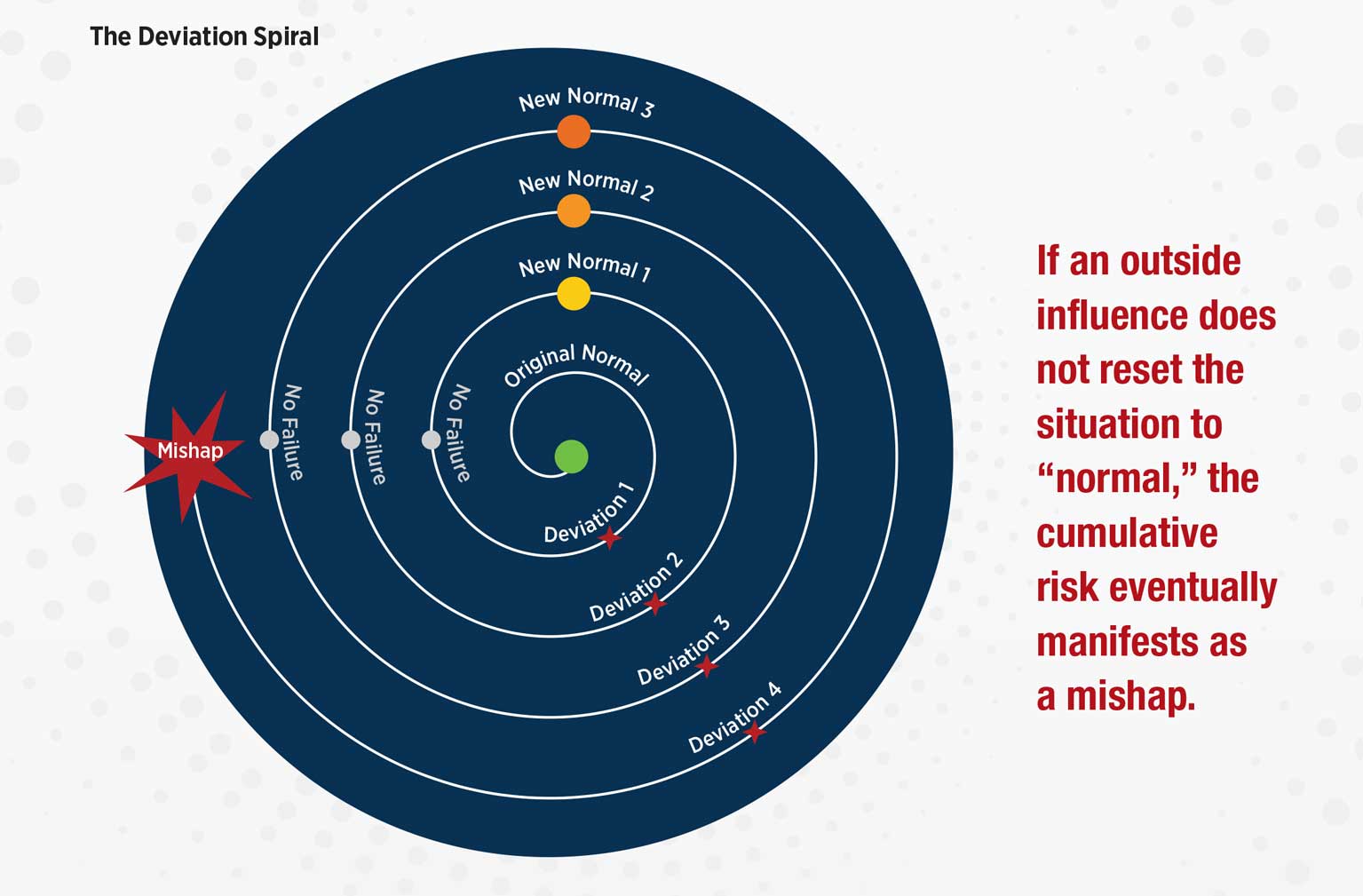
While the actions and mishaps associated with Normalization of Deviance have surely existed as long as human endeavor, the term itself is relatively new; it was coined not by a safety professional, but by a passionate sociologist named Dr. Diane Vaughan. In the wake of the nineteen eighty-six Space Shuttle Challenger tragedy, she embarked on a quest to discover how an organization like the National Aeronautics and Space Administration (NASA), known for its attention to detail and safety consciousness, could have succumbed to organizational pressures to launch. In her book, The Challenger Launch Decision: Risky Technology, Culture, and Deviance at NASA, Vaughan defines Normalization of Deviance as “the gradual process through which unacceptable practice or standards become acceptable. As the deviant behavior is repeated without catastrophic results it becomes the social norm.” She also noted that the move from “not ok” to “ok” is insidious, disguising the true risks in a situation and leading to poor decisions. A year later, safety researcher Dr. Jens Rasmussen demonstrated how Normalization of Deviance is not, in fact, static; it shifts in response to resource, performance, and workload pressures. If an outside influence does not reset the situation to “normal,” the cumulative risk eventually manifests as a mishap.
So, what is the intrepid safety Airman to do? How do we embrace the changes necessary to meet the challenges of twenty-first-century combat while keeping risk manageable? Initially, we must teach other Airmen and commanders our safety “Weirding Way;” show them how to recognize hazards and risk patterns like Normalization of Deviance. Once they know what to look for, they can guard against it and make smart decisions based on a holistic risk picture. Secondly, we, as safety professionals, must learn to stop worrying and love Standardization and Evaluation (Stan/Eval) and Quality Assurance. While Safety has a different mandate than Stan/Eval, their functions and evaluations are crucial to realigning performance with procedural processes and enforcing standards, both are essential to proactive safety. Finally, safety Airmen should be involved and engaged with the innovation process from the beginning. Safety is sometimes seen as the shop of “no;” we need to change that to the shop of “yes, and.” This is how we ensure innovation and experimentation for twenty-first-century airpower has risk management and safety built in from the beginning—Aim High!