
Why Are Aviation Safety Action Program Submissions Declining? A Reminder of Why We Should Care
By Ops RAMS Branch
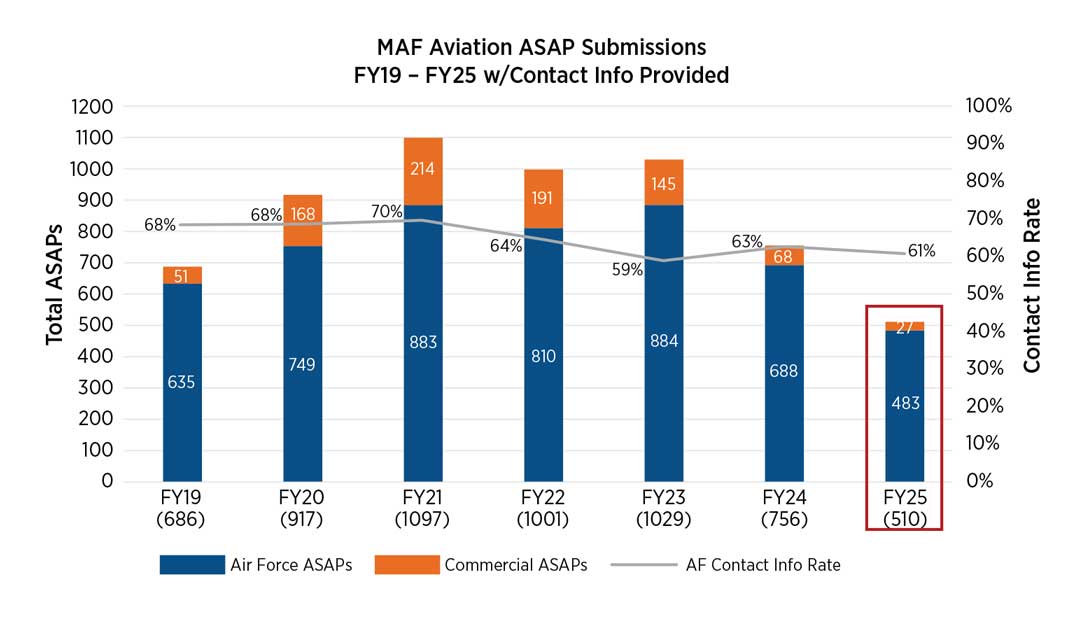
During the August 2025 Operations Risk Assessment and Management System (Ops RAMS) Working Group, the chart shown on this page was presented, which visually depicted a significant decline in the number of Mobility Air Force Aviation Safety Action Program (ASAP) submissions. In fiscal year 2025, there have been only 483 ASAP reports submitted thus far. With ASAP submissions historically averaging approximately sixty per month and only one month remaining until the FY25 closeout on September 30, we are tracking toward 543 total ASAP reports for the year. This number is well below the fiscal year 2024 total of 688 ASAP reports. Unless there is a miraculous change in the next month, the outlook appears disappointing.
I will pose to you the same question we asked during the Ops RAMS Working Group meeting: Why is the number of ASAP submissions declining? There are a lot of good theories that potentially answer the question. Perhaps the number of flying hours has decreased; thus, the decrease in ASAPs is commensurate with the decrease in flying hours. Maybe aircrew do not understand the value of the ASAP program. Maybe aircrew are too burdened with post-flight paperwork and do not want to submit another report. Although these are plausible theories, we do not know the answer as to why the number of ASAP submissions has declined. As highlighted in the Terms section of DAFI 91-225, Aviation Safety Programs, ASAP is a “voluntary, identity-protected program designed to encourage the reporting of hazards and errors that increase risk to operations.” Voluntary means the program is a human endeavor in which our Airmen “get a vote” in whether they participate in this vital safety program. The other word in the program description that we should ponder is “encourage.” Who encourages our Airmen to participate in the program? How do we encourage our Airmen to participate in the program?
Rather than trying to answer the difficult question of why there is a decline in ASAP submissions, we should turn our focus back to the foundation of the ASAP program. The foundation of our proactive safety programs, which include ASAP, Military Flight Operations Quality Assurance (MFOQA), and Line Operations Safety Audit (LOSA), is Just Culture.
James Reason, the Swiss Cheese Model, and Just Culture
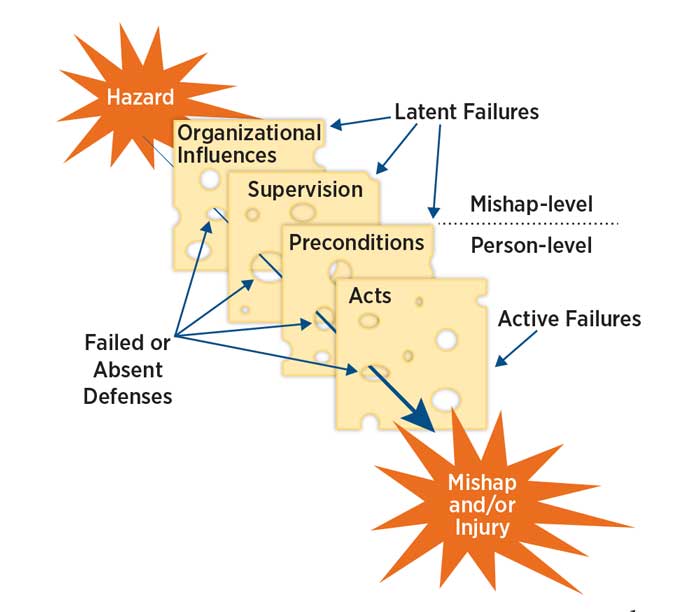
You may not know the name, but you certainly know his work. James Reason was a British professor of psychology at the University of Manchester. His work focused on human error, aviation human factors, risk management, and accident causation. The Swiss cheese model is a concept developed by Reason, in which he visualized how holes in our layers of system defenses, when perfectly aligned, can lead to an accident. Reason transformed how we think about human error. He changed our approach to safety from focusing solely on the failings of an individual to a system approach in which an accident is the result of organizational failings that breach multiple layers of defense.
For organizations to uncover the holes (weaknesses) in the Swiss cheese, Reason asserted that organizations needed to transform their safety culture to provide incentives for employees to report honest mistakes while balancing accountability for actions. Through open error reporting, organizations would have better awareness and understanding of their errors and hazards, and the potential to mitigate hazards before an accident occurs. Reason’s assertion is Just Culture. We see Reason’s blueprint in our own Air Force definition of Just Culture. DAFI 91-225 defines Just Culture as follows.
“An organizational environment where individual Airmen and Guardians are not punished for actions, omissions or decisions taken by them that are commensurate with their experience and training, but where gross negligence, willful violations and destructive acts are not tolerated. Just culture focuses on improving system designs and employee procedures to include: better system operations; creating redundant safety systems to trap or mitigate errors; pre-identifying high-risk operations; and leadership actions designed to limit at-risk behaviors.”
Reason advocated for an organizational culture shift. Reason reasoned that expecting flawless performance by humans was unrealistic; thus, it was better to reveal honest errors and workplace hazards so that system defenses could be employed to prevent mishaps. Therefore, Just Culture is a benefit to the organization.
Safety is Everybody’s Business
When we see the decline in ASAP reporting, the simple response is to zero in on our frontline Airmen who should be reporting, as the responsibility of reporting lies with them. However, as the ASAP program description highlights, we need to look beyond our frontline Airmen and look at our entire organization for the encouragement and investment necessary to demonstrate why Just Culture is the lifeblood of a beneficial, proactive safety program.
Although the phrase “safety is everybody’s business” might be cliché, the mantra is a truism. A healthy safety culture requires participation from all levels of the organization. Let us go through the different organizational echelons and discuss what roles they play in building and solidifying a strong proactive safety culture.
Commanders: The bedrock of the organization is its leadership. Leaders, specifically commanders, play a pivotal role in the organizational culture and behavior. A commander’s attitudes, beliefs, and policies shape and refine an organization. A Just Culture begins with a commander defining and communicating a Just Culture safety policy. It cannot stop there. Commanders must define acceptable and unacceptable behaviors. Definitive descriptions help Airmen understand the commander’s expectations and how the commander will apply a Just Culture concept in the event of an incident. Clear, definitive policies, definitions, and expectations help build trust in a transparent process.
The bottom line is that commanders should give line aircrew assurances that a Just Culture accepts honest mistakes, thereby enabling voluntary participation in a trustworthy and transparent safety program and process. A strong Just Culture should empower a vibrant reporting culture.
Aircrew: Obviously, the primary role of aircrew in these proactive safety programs is voluntary participation. Consistent voluntary reporting by aircrew helps us to see the strengths and weaknesses in our flight operations. Being in a flying squadron, aircrew see what works well and what does not in our flight operations. Through the eyes of the aircrew, ASAP reporting gives the organization critical insights into the context of the event and the operational impact when our operations fail. The reporting allows us to methodically analyze situations, evaluate risk, and seek mitigation efforts without the cost of a mishap.
Finally, I would like to dispel a couple of aircrew misnomers about ASAP reports:
- What is “ASAP worthy?” So many times, we hear from crews that their flight or event was not “ASAP worthy.” We have this false perception that “ASAP worthy” events are these ginormous, task-saturating, on-the-brink-of-death flying scenarios that we somehow manage to live through and tell. Although there are harrowing events in flying, those events are rare. Like most FAA formal deviations, ASAP events are normally short in duration, usually involving two undetected errors and a deviation from the intended flight path, which can be vividly described in three or four sentences. Your everyday flying experiences are “ASAP worthy.”
- All aircrew members can contribute. Once again, there is a misconception among aircrew members that the aircraft commander decides and writes the ASAP reports, which is false. All crew members are encouraged to contribute voluntarily to the ASAP program. Different perspectives and experiences are important in seeing the complete picture of flight operations. For example, the loadmaster is the primary crew position that interacts with the aerial port and the expert when it comes to cargo operations; therefore, it is important to examine what they observe and manage daily.
Functional Areas: Functional areas, such as standardization/evaluation, maintenance, training, command and control, aerial port, and air traffic control, play a major role in the life cycle of an ASAP. Most often, functional area experts provide critical analysis and trends from events highlighted in proactive safety data sets. Likewise, they should be an integral part of the process for deciding and implementing risk mitigation efforts in their area of expertise.
Functional areas are very much interested in events or data points delivered by the ASAP program. ASAP reports give functional areas keen insights into the performance of aircrew, systems (hardware/software), programs, and products, as well as standards, policies, and procedures for their functional area; however, ASAP reports are not a “one-way street.” Providing feedback and acknowledgment to aircrew is vital in maintaining a robust voluntary reporting system.
Functional areas have a responsibility to provide a written response to an ASAP addressing hazards and deficiencies in procedures, hardware/software, equipment, and processes that are owned by their functional area. Functional areas cannot be selective as to which ASAPs they respond. Responses to ASAP submissions are a vital part of the program’s success. Their analysis and response provide action, follow-ups, and closure to the crew members who provide voluntary safety inputs.
Safety Professionals: As the functional area responsible for these safety programs, safety professionals are in a unique position to advocate for a Just Culture, act on ASAP submissions, and promote voluntary contributions by crew members. Through commander orientation/immersion briefings, chiefs of safety can encourage new commanders to embrace a Just Culture and incorporate it into their safety policies and briefings. Likewise, safety professionals play an active role after an ASAP report has been submitted. Safety officers will sometimes investigate an ASAP event to extract lessons learned and recommend a course of action to prevent similar mishaps. Finally, safety professionals should promote voluntary reporting by our aircrew. During safety briefings or “hangar fly” discussions, showcase ASAP submissions and how everyday reporting makes a difference in our mishap prevention efforts.
We All Play a Role
Now, you should realize that we all play a role in the success or failure of our Just Culture and proactive safety programs. These voluntary safety programs are only as good as the time, effort, and focus put forth by the organization. We are the organization. We all benefit from a strong Just Culture in which we own the mistakes that we make without the need for punishment. Commanders create the organizational climate and set the example for a Just Culture. Functional areas appreciate ASAP submissions from line aircrew by examining the ASAPs for hazards and errors and identifying how preventative measures can be potentially implemented to mitigate the risk of a mishap. Functional areas provide meaningful responses back to the line aircrew, closing the loop by providing analysis, feedback, and actions taken. Safety professionals promote, advocate, and resource proactive safety programs. Line aircrew provide meaningful reporting. Simply put, everyone is a stakeholder in our safety culture.
Wrapping It Up—It Is not That Easy!
In conclusion, looking at the ASAP submission chart, the simple, uninformed answer is that we need more ASAP production. The reality is that a meaningful proactive safety culture and program is not that easy. Reason advocated for a change in organizational safety culture. Changing the organizational culture is never an easy task, especially for a large Department of War organization that has been around for nearly eighty years. Changing a culture requires advocates to promote a change in thinking, which shifts organizational principles, beliefs, and policies. It requires education and training throughout the entire force structure to reinforce those principles, beliefs, and policies. It requires translating concepts and policies into practical application standards and resources needed to sustain the change. Ultimately, it requires continual reinforcement to ensure that the culture stays connected to the organization.
When we see those declining ASAP numbers, we should care. It should serve as a reminder that ASAP and our other proactive safety programs are voluntary and anchored in a Just Culture. It should serve as a reminder that we all play a role in our organizational safety culture, which in turn influences whether our Airmen participate in these programs. We should not take for granted what those safety programs deliver.