
Drones: Sustaining and Enhancing Operations
By Ms. Lauren Fosnot, Staff Writer
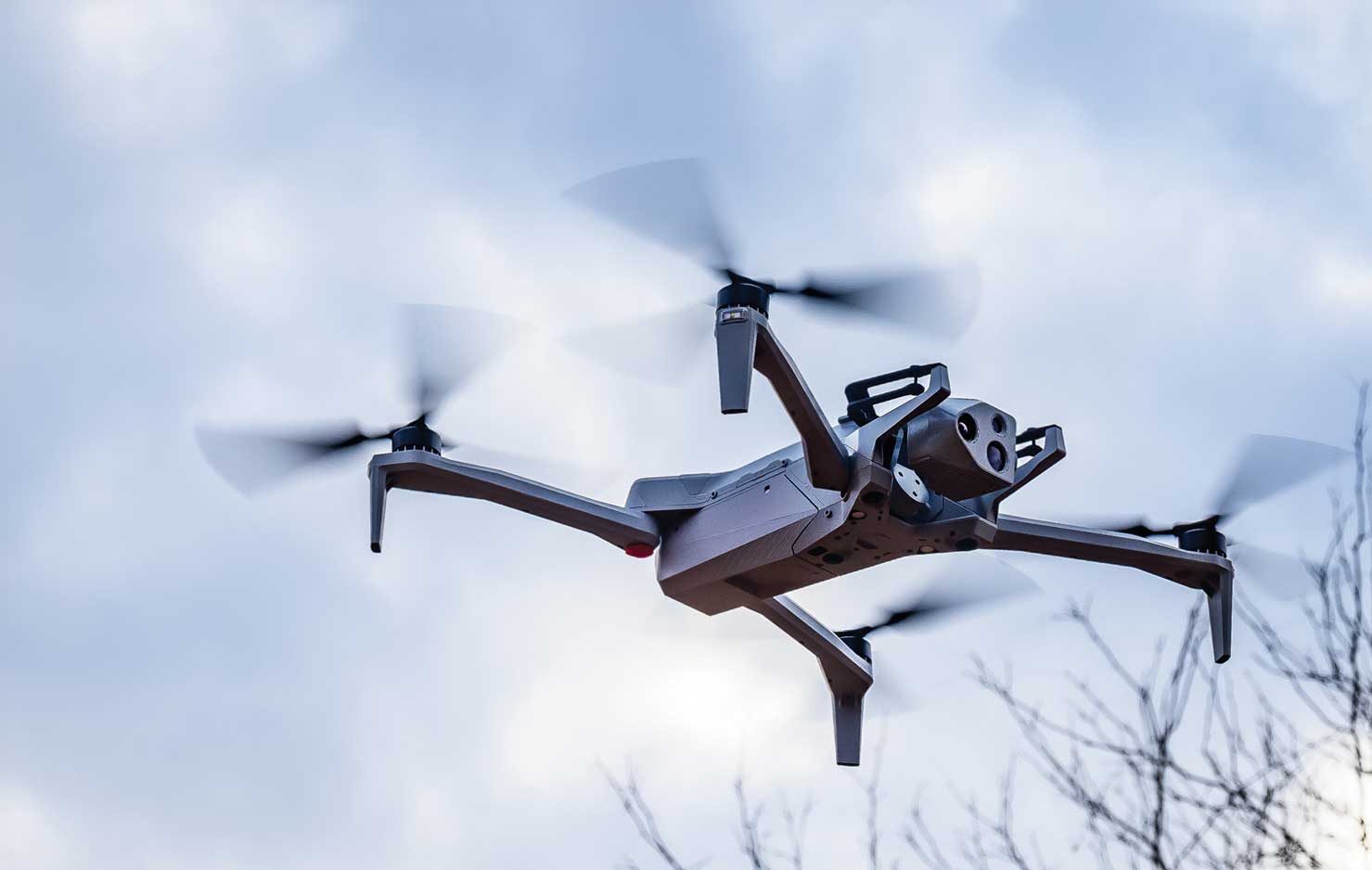
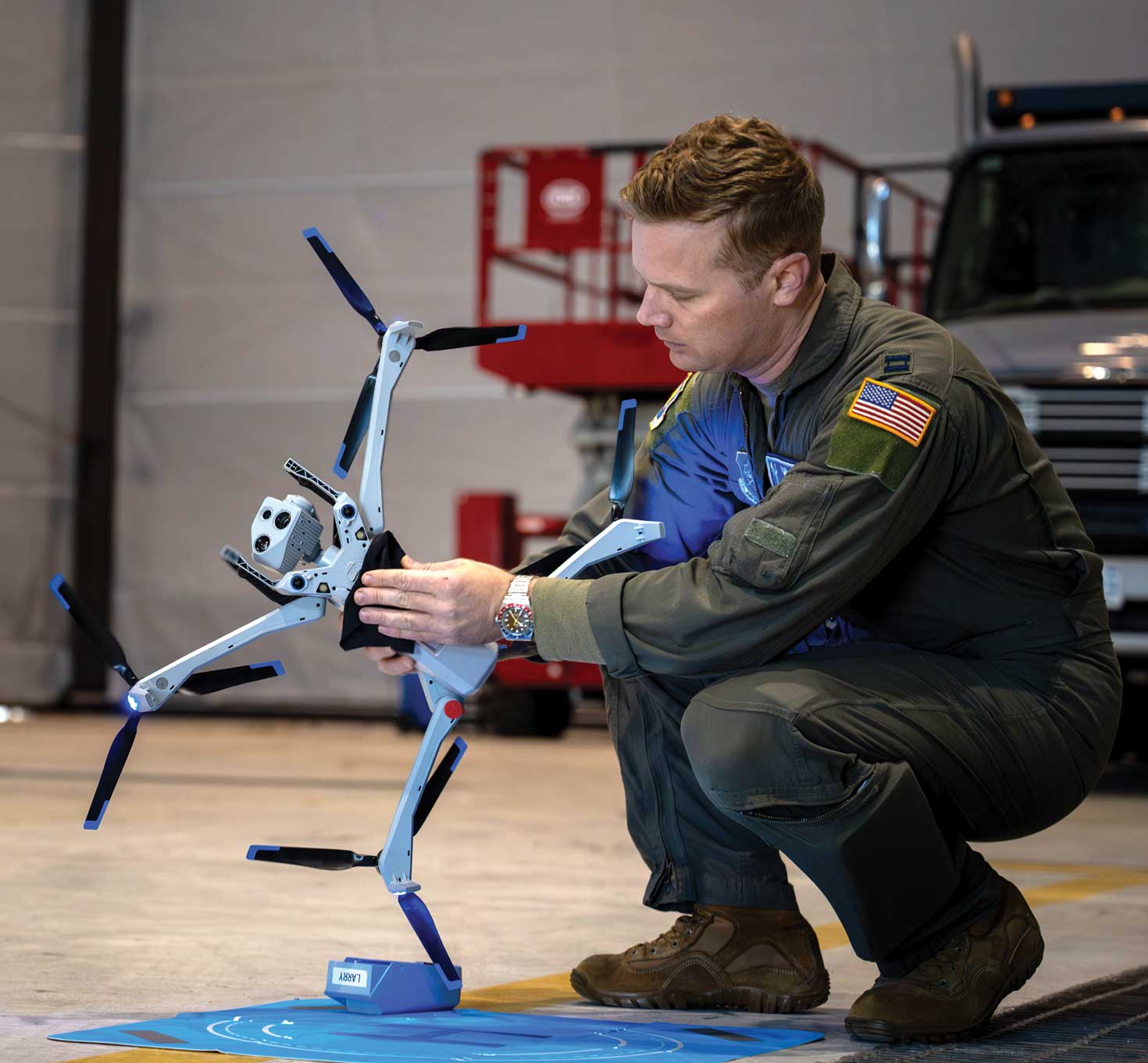
In today’s ever-evolving battlefields and mission areas, drones provide a unique capability to free up human resources and access hard-to-reach spaces, enhancing effectiveness and supporting operations in ways other assets cannot. Chad Zeigler, an Air Mobility Command (AMC) Small Unmanned Aircraft Systems (sUAS) Program Manager, explained how a security drone conducts perimeter sweeps instead of humans. Not only are human assets protected from potential dangers, but they are free to do work that only a person can perform at this time. He also explained how drones aid in maintenance inspections of an aircraft’s tail and more. Today, these drones incorporate artificial intelligence (AI) to enhance the identification of parts and pinpoint deficiencies.
Drones are especially important in today’s climate of harsh, contested, or degraded environments and enable technological advancements that contribute to the future fight. Whether enhancing a warfighter’s capabilities or delivering goods and supplies to a disaster zone, drones bring a new type of capability that drives innovation and capacity.
“We have to leverage technology [to] sustain our capabilities,” said Zeigler.
Due to the changing characteristics of war, the ability to scale up drone production and deployment is paramount, explained AMC sUAS Program Manager Patrick Richard. Not only is producing the most advanced devices important, but ensuring the most efficient quantities is also important for readiness. He added that many career fields contribute to drone technology development and implementation, making it a vast field.
In the next five to ten years, Zeigler anticipates drones further enhancing the AMC mission by, for example, delivering materials and supplies more efficiently. He believes enhancements in the Airborne Intelligence, Surveillance, and Reconnaissance (ISR) field are likely. “It’s changing the battlefield,” he remarked. “It’s . . . delivering lethal capability to enhance the warfighter.” He also noted that ISR missions designed to collect data and observe the forward-operating enemy will be crucial. “Now, you don’t have to put somebody in harm’s way,” he stressed. “That drone does everything. And with the emergence of AI, you have the capability of that software learning stuff on the fly—friend versus foe, nefarious users, all that kind of stuff.”
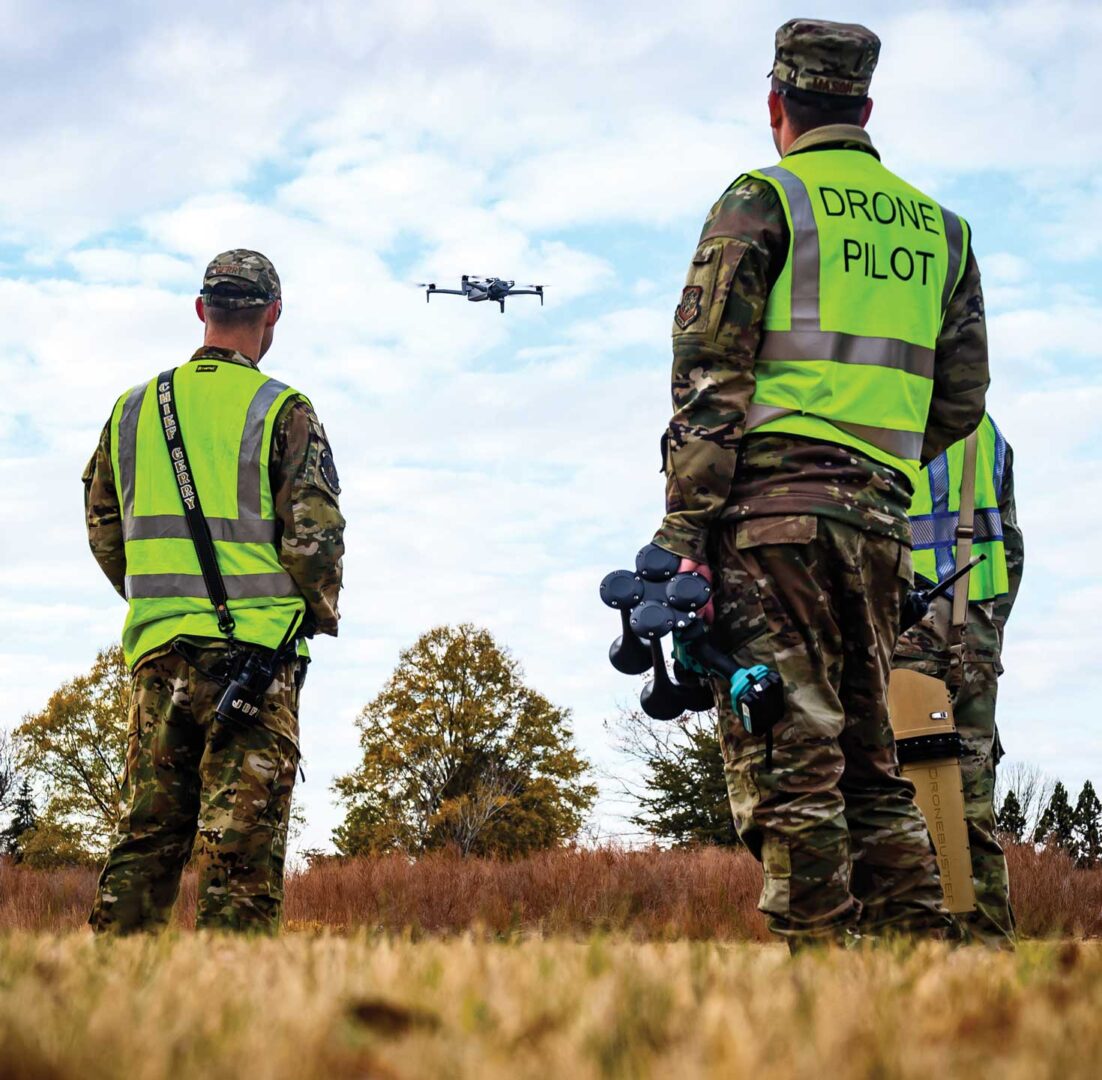
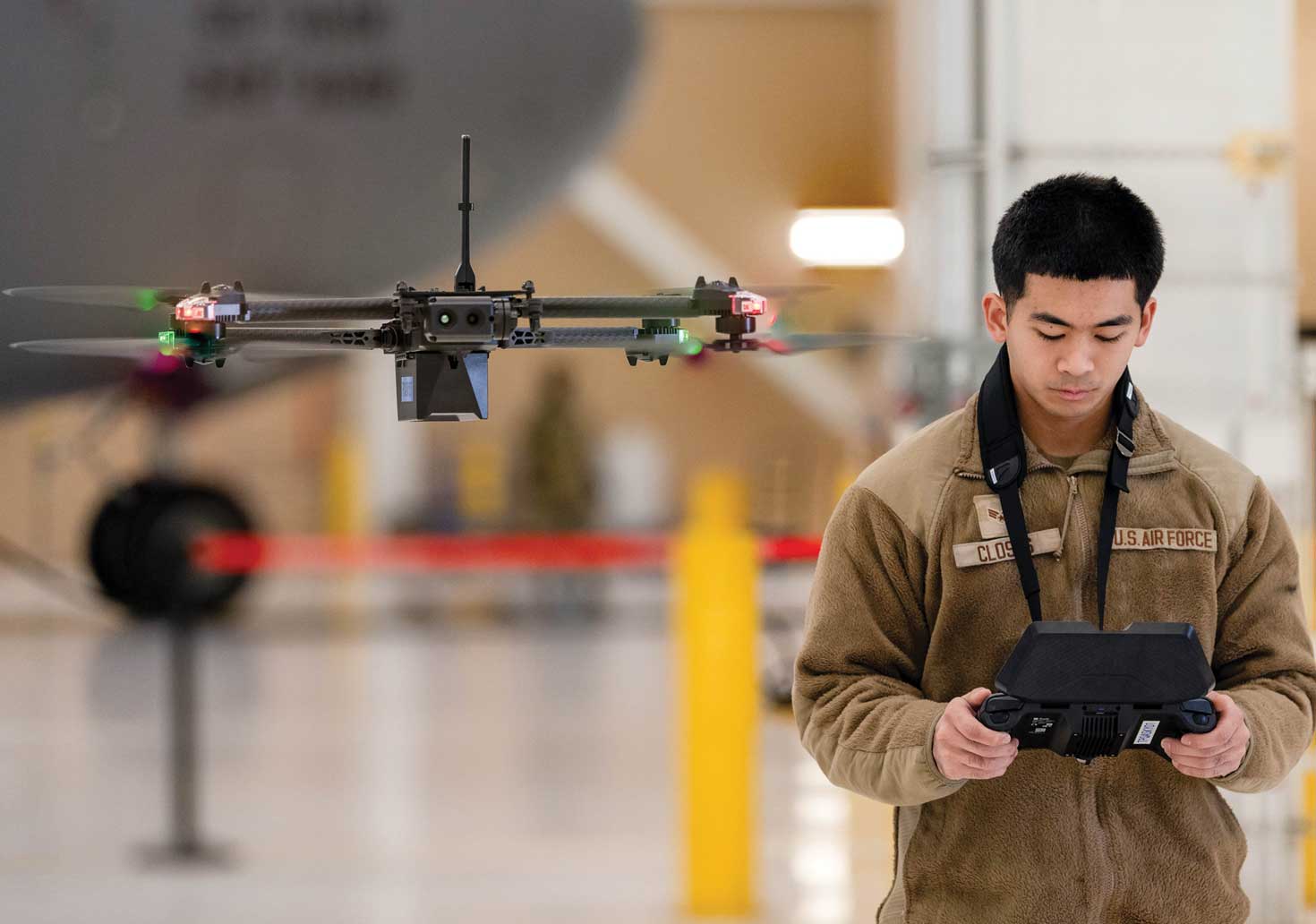
Richard suggested that drone technology could improve mission-support capabilities. He envisions enhancements to the operating system that would enable multiple Airmen to operate more than one drone at a time, allowing several drones to contribute to completing a mission and returning to base with important data, deliverables, and insight. Richard also sees unmanned in-air refueling as a strong possibility in the future.
Some of the biggest logistical and technical challenges in deploying and sustaining drone operations include ensuring timely and up-to-date training and managing the ever-evolving technological nature of the system.
Zeigler named an additional challenge: different operating rules and regulations depending on the environment or location. “When you look overseas, you’re not in your own country. You’ve got to abide by the red tape—the rules [and] requirements that are levied by that foreign nation.” Richard noted that overseas environments can be congested for small, unmanned aircraft systems: “It’s very difficult if there’s constant jamming of those drones.”
Zeigler encourages Airmen to learn how drones can support their missions. “It’s [an] emerging technology that needs to be embraced because it’s only going to positively affect their [execution of] mission sets.”
Similarly, Richard acknowledges that the Air Force has extremely smart, talented, and gifted Airmen. He encourages Airmen not to become intimidated by the various rules and regulations surrounding drone usage, but to be patient and embrace a drone’s innovative capabilities, knowing that the future of operations is evolving.
Earlier in the year, Exercise Mobility Guardian 2025 included the use of drones. Richard understood that incorporating drones into the exercise “was just really to get the Airmen to start thinking about the battlefield from not just a two- or three-dimensional but four-dimensional perspective.”
Drone usage and collaboration will likely expand in future exercises and readiness across many perspectives, including offensive, defensive, and tactical.
“We’re really starting to embrace it; the sky’s the limit as far as the use cases that will be developed going forth,” said Zeigler.